
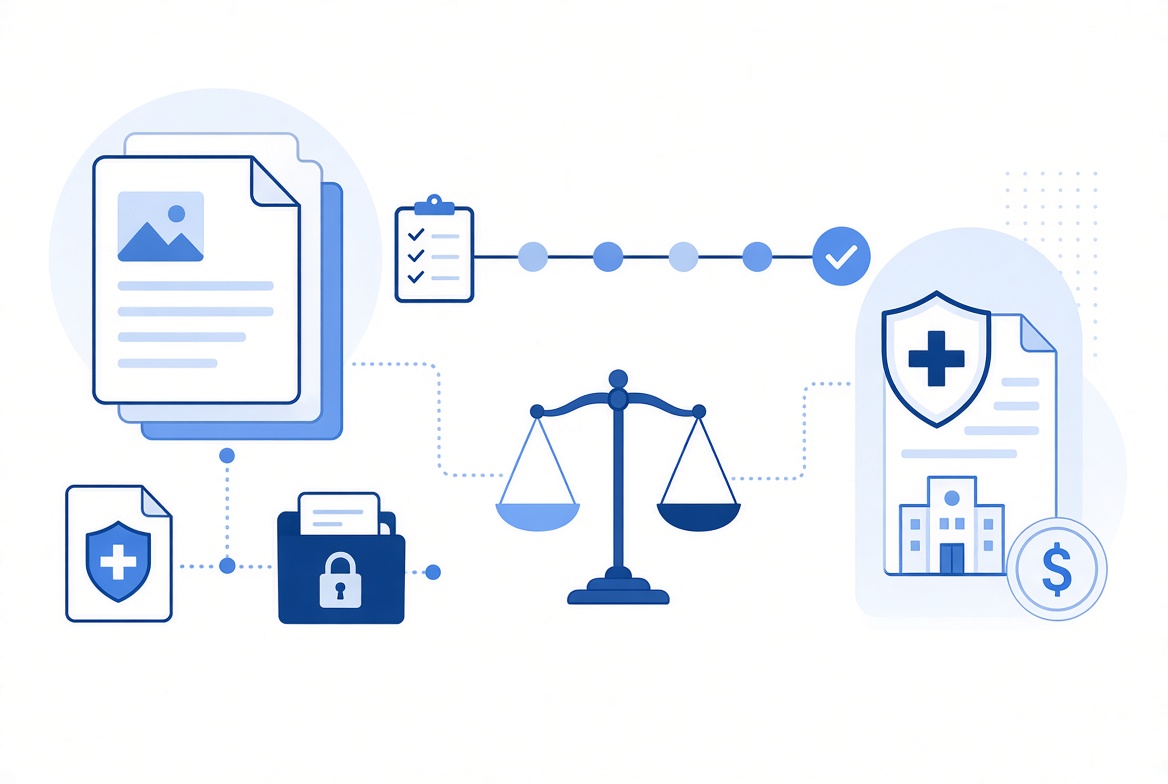
The No Surprises Act does not establish a single appeal route for every out-of-network medical claim. The federal Independent Dispute Resolution (IDR) process concerns certain covered out-of-network items and services, and whether a dispute qualifies depends on the plan, provider, service setting and applicable federal or state rules.
Before opening an IDR matter, verify the claim’s eligibility. Do not classify a commercial payer claim as eligible solely because the provider considers its payment insufficient.
For non-attorney preparation and dispute-documentation workflows, review Millennova Legal’s Federal IDR support. Its resources are supplementary to official CMS instructions.
Build a claim-level eligibility record
A review worksheet should capture the coverage and plan category, date and location of service, provider or facility, relevant network status, original submitted claim, initial payment or denial documentation, and any state-law or other process that governs the payment question.
Separate eligibility questions from the merits of a proposed payment amount. A missing submission, incomplete provider record or mistaken plan classification should be identified before administrative costs accrue.
Control notices, negotiation and dispute windows
Federal open negotiation and dispute initiation have prescribed requirements and exceptions. CMS maintains current operational instructions and notices. Create a timeline that identifies the actual triggering notice, verified period, responsible person and documentary evidence of each action.
Avoid copying fee amounts or deadlines from old marketing articles. CMS updated the federal IDR administrative fee for disputes initiated on or after June 11, 2026, and its notices page distinguishes the applicable fee by initiation date. Teams should validate the current rules immediately before initiating a dispute rather than hard-coding them into a static checklist.
Make the evidence package reviewable
Organize the claim documentation in a stable index: submitted claim and status history, payer remittance, notices, open negotiation record, relevant plan facts, supporting documents, offer assumptions and proof of transmission. Maintain an audit trail for additions and corrections.
A documented reason for a rejection or ineligibility decision is as important as the payment outcome. This enables supervisors to improve the screening process without misclassifying administrative failures as financial losses.
What can be delegated?
Administrative preparation, claim classification worklists, evidence tracking and status reporting can be supported by trained revenue-cycle personnel under an agreed scope. Legal advice or advocacy should be handled by authorized counsel where applicable.
Official references: CMS: About the Federal IDR process and CMS: Current notices, administrative fees and operational changes.
For non-attorney intake and evidence coordination, see our NSA / IDR support services or request an operations review. This article is general operational information, not legal advice.
Federal IDR is not a universal out-of-network appeal
A claim needs a positive eligibility determination based on the covered item or service, payer and plan, relevant state law and provider/facility status. Billing teams should distinguish standard patient appeals and contractual negotiations from qualifying federal IDR disputes. A CARC or RARC may inform review but does not prove federal jurisdiction.
The open-negotiation stage is a distinct procedural requirement; track notification, delivery and response as source evidence. CMS describes a 30-business-day open-negotiation period and a generally four-business-day initiation window afterward, subject to applicable extensions and rule changes. Confirm current CMS notices for the specific dispute.
Build the case file before drafting an offer
- Retain the initial payer payment or denial with line-level identifiers.
- Verify the qualified payment amount disclosure where applicable; do not equate it with the automatic winning offer.
- Separate clinical factors, service characteristics and documented payment information from unsupported market-rate claims.
- Record the accepted determination and reconcile any resulting payment; favorable decisions are not deposits.
The article addresses administrative operations and evidence quality. Legal advice, regulatory interpretation or representation should be handled by appropriately qualified professionals.
Example: why the same low payment can lead to different next steps
Consider two OON claims with identical billed charges and different health plans. One claim may be governed by applicable state payment law; another may fall under the federal NSA pathway after separate eligibility verification. Payment size does not resolve jurisdiction. The case file should explain why a federal or nonfederal process was selected and cite the controlling source.
What is the QPA’s role? It is part of the applicable regulatory information and may be relevant to the dispute, but neither a billing estimate nor the QPA should be described as an automatic winning price.
What happens after a decision? A team must reconcile any required payment and separately address a shortfall; it cannot assume that a closed federal case has produced a bank deposit.
Governance
Keep negotiation notices, arguments, evidence and final offer versions separate. Do not attribute a legal conclusion to a billing analyst. A quality reviewer should be able to trace claim-level eligibility, the negotiation chronology and the final financial outcome back to original documents.
References
Editorial update: October 11, 2026. Validate current payer requirements and jurisdiction-specific guidance before operational use.