How coding errors drive claim denials, the difference between medical billers and coders, compliance risks, and practical controls that protect revenue and reduce audit exposure.
Identify frequent medical claim denial reasons using accurate CARC/RARC classifications, map them to upstream process failures, and apply targeted controls that reduce rework for U.S. healthcare revenue cycle teams.
Compare the real cost of handling medical billing in-house versus outsourcing, including staff hours, software, denial rework, and transition risk for U.S. practices.
What insurance verification actually requires, how to track claim and payment status, and the operational steps that reduce preventable denials and delayed payments.
Key performance indicators for medical billing, how payment posting and reconciliation work, and practical steps to reduce days in A/R and manage aging balances.
A practical checklist of questions for practices assessing medical billing, denial management, or RCM partners, focused on scope, reporting, access, and transition risk.
Understand the complete medical revenue cycle from patient registration through final payment, how it differs from basic billing, and why structured RCM reduces revenue leakage for U.S. practices.
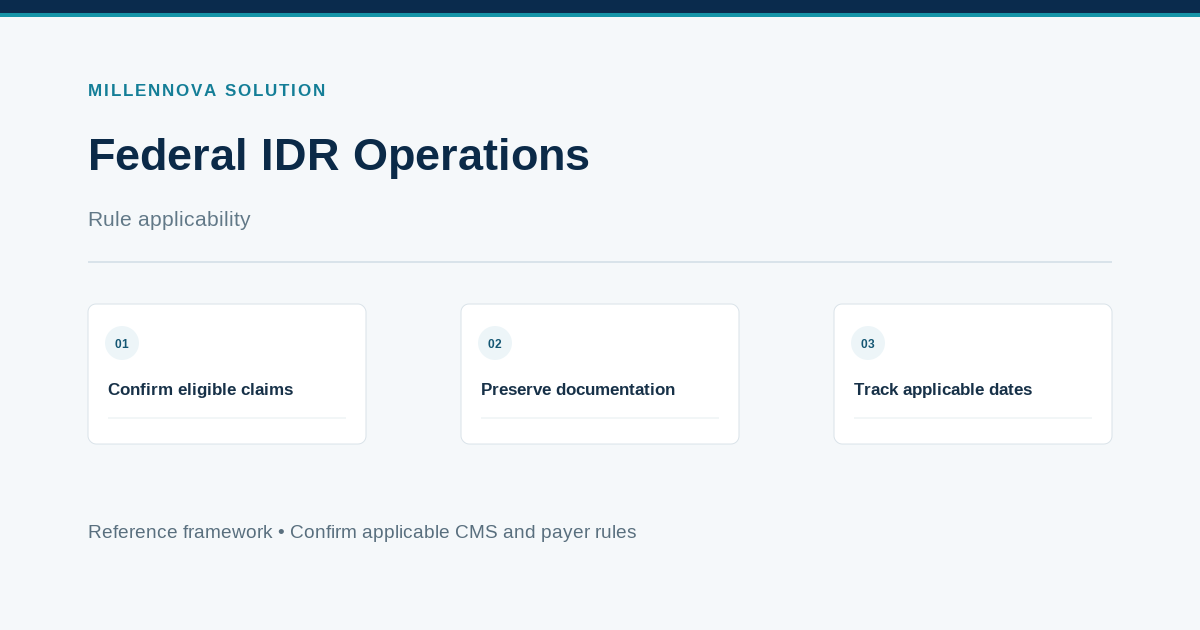
The federal independent dispute resolution administrative fee dropped to $15 per party. Review applicability dates and how the change affects dispute-initiation decisions under the No Surprises Act.
Key documentation, unit calculation and reconciliation points for time-based anesthesia services, medical direction and supervision claims in revenue cycle management.
How revenue cycle teams use claims data, remittance patterns, CARC/RARC codes and price transparency information to prepare for payer negotiations, underpayment recovery and contract discussions.
Common operational review areas for joint replacement, fracture care, global-period modifiers and implant documentation in orthopedic revenue cycle management.
How medical billing teams use denial patterns, CARC codes and pre-submission edits to reduce preventable denials and improve clean-claim rates in revenue cycle management.
How to separate aged medical receivables into cohorts that may still have a documentation, appeal or negotiation path versus those that should be closed with a documented reason.
Operational notes on monitoring whether a federal independent dispute resolution payment determination is paid within required timelines under the No Surprises Act.
How remittance advice codes under the 2026 Federal IDR final rule help revenue cycle teams determine which claims may be subject to No Surprises Act open negotiation and independent dispute resolution.
Evaluate clearinghouse acknowledgments, claim edits, payer responses and billing workqueues without promising a fixed medical accounts receivable turnaround.
An operational guide to tracking current CPT and ICD-10 code-set changes, payer edits, documentation checks and billing quality assurance without unsupported rejection claims.
A practical security due-diligence guide for healthcare billing vendors using cloud systems, covering access, logging, business associate agreements and risk review.
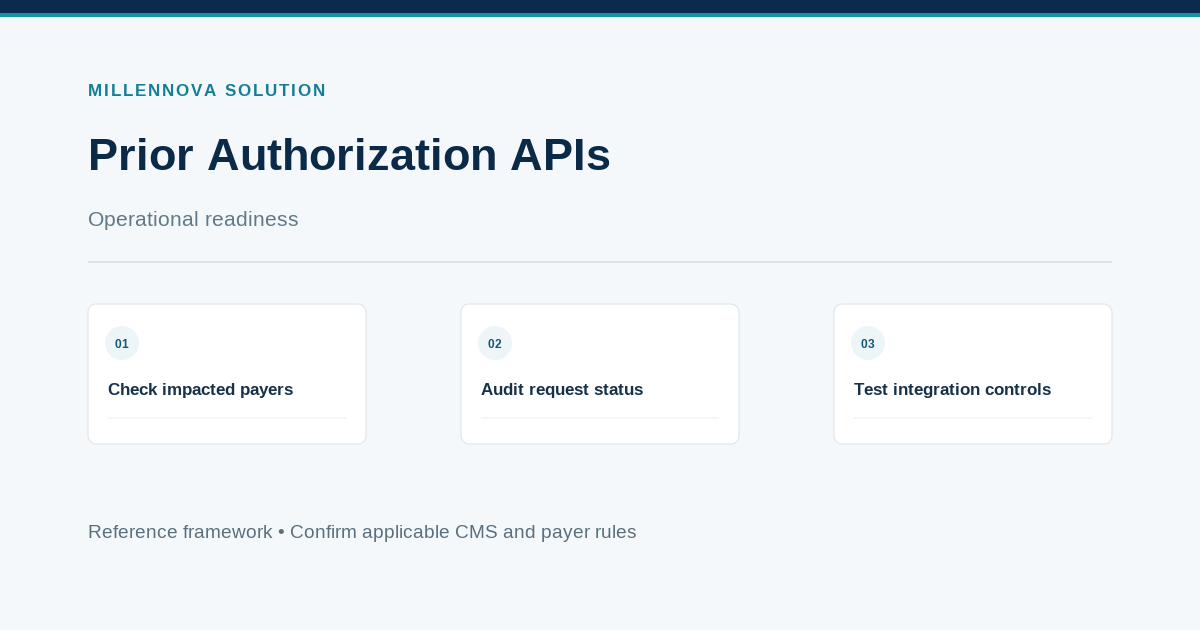
Learn how medical billing teams should evaluate FHIR data exchange, source mapping, permissions, reconciliation and safe EHR integration before implementation.
Assess evidence collection, claim eligibility screening, submission controls and status reconciliation for federal independent dispute resolution workflows.
A workflow-focused overview of payer identification, injury-claim documentation, remittance follow-up and escalation responsibilities for provider billing teams.
An operational checklist for practices changing medical billing partners without losing claim history, outstanding A/R visibility or responsibility for payer follow-up.
Review claim eligibility, payer notices, open negotiation evidence, dispute tracking and current CMS references for federal No Surprises Act IDR support.
A practical documentation, coding review and exception-management framework for provider billing teams seeking to reduce unsupported codes and missed charges.
A finance-focused framework for measuring denial rework, distinguishing claim rejections from denials, and identifying recoverable revenue-cycle bottlenecks.
Explore governance, reconciliation, source evidence and review controls for outsourced accounting operations serving organizations reporting in the U.S. and U.K.