
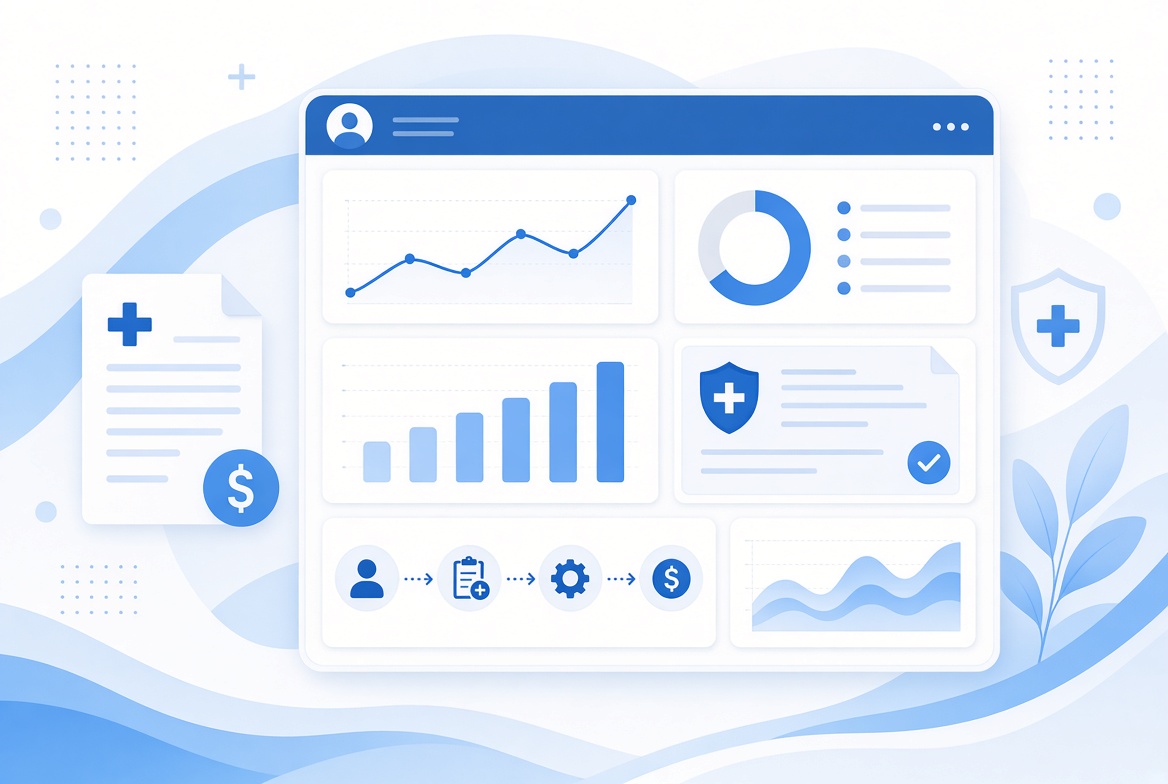
A clearinghouse connection can improve visibility into the journey of a medical claim. It cannot guarantee that a payer adjudicates or pays within 14 days. Financial outcomes depend on coverage, documentation, payer processes, correct submission, benefit rules and follow-up capacity.
The phrase “API-first” is helpful only when the billing organization has clear answers about what will be sent, which acknowledgments will return and how missing information will be resolved.
Map the claim lifecycle
Document each stage from charge creation through clearinghouse validation, payer acceptance, adjudication, remittance, posting, reconciliation and subsequent denial or balance work.
A rejected transmission is different from a payer denial. A request for additional information is different from a final payment. A/R reports should preserve these distinctions so that follow-up teams can use the correct workflow.
Specify the integration contract
A useful vendor evaluation covers transport and supported transaction formats, test environments, validation rules, request identifiers, message-level acknowledgments, batch-level acknowledgments and error detail. Include expected retry behavior and recovery after an outage.
Do not design around the assumption that every vendor has an open real-time API. Some billing operations rely on standard healthcare EDI transactions and secure file exchanges. Choose the integration pattern that the specific vendor contract actually permits.
Treat exceptions as first-class data
For each unsuccessful step, record the original claim reference, authoritative response, time received, next action, accountable team and due date. Provide a human review path for ambiguous cases.
Claims that appear duplicated, accepted but unposted or transmitted without acknowledgement should not be silently marked successful. Reconcile aggregate activity to the practice’s source billing and payment records.
Use measurements that support decisions
Track claim acceptance, clearinghouse rejection trends, payer denial categories, elapsed time between stages and the age of unresolved workqueues. Show the measurement definitions so financial and operations teams can interpret the same report.
A healthy integration reduces avoidable friction and improves accountability. It does not by itself establish a predictable cash-collection duration.
Review our software development services, medical billing operations, or request a workflow assessment.
Do not confuse successful transmission with accepted claims
An API’s 200-level response may confirm that a file arrived at an intermediary, not that the payer has accepted or adjudicated it. Trace the outbound 837, technical acknowledgment, payer acceptance or rejection, claim-status feedback and final 835 remittance as distinct events. Every reconciliation should preserve claim, service-line and trading-partner identifiers.
A 14-day target can be framed as an internal follow-up service objective, but payment timing is not controlled entirely by the billing team. Better indicators include time to clearinghouse acceptance, time to resolve first rejection and time from posting to deposit reconciliation.
Failure testing before production adoption
- Duplicate retries: require stable claim identifiers and a controlled resubmission pathway.
- Missing acknowledgment: queue an exception rather than silently marking the claim accepted.
- Out-of-order messages: preserve the original event timestamp and the current verified claim status.
- Partial payment: reconcile at service-line level, leaving unresolved amounts open.
- Connection outage: surface the affected submissions before timely-filing exposure.
Test with synthetic or safely de-identified data, using the payer or clearinghouse’s applicable companion guide. The goal is accountable exception handling, not a blanket promise to accelerate collections.
What a service-level dashboard should actually show
Design three separately measured stages: submission to technical acknowledgment, acknowledgment to payer acceptance, and accepted claim to adjudication. Add a fourth measure for remittance-to-bank reconciliation where finance requires it. Report median and upper-percentile elapsed times rather than only averages, because delayed exceptions are the claims that most need attention.
What happens when an API request times out? A timeout does not prove a claim was never received. Query the prior submission identifier before retrying, so staff do not generate duplicate claim traffic.
What should an integration audit retain? The transaction version, trading-partner endpoint, message ID, claim-control identifiers, delivery attempts, acknowledgments and final decision. Logs containing PHI need the same access discipline as production records.
Pilot release gate
Start with a limited synthetic transaction set, then move to approved low-risk claim cohorts. Reconcile counts and financial fields at each hop. Expansion is justified by sustained accuracy and exception-resolution performance—not merely a lower average API response time.
References
Editorial update: October 11, 2026. Confirm the current requirements and applicable payer rules before operational use.