
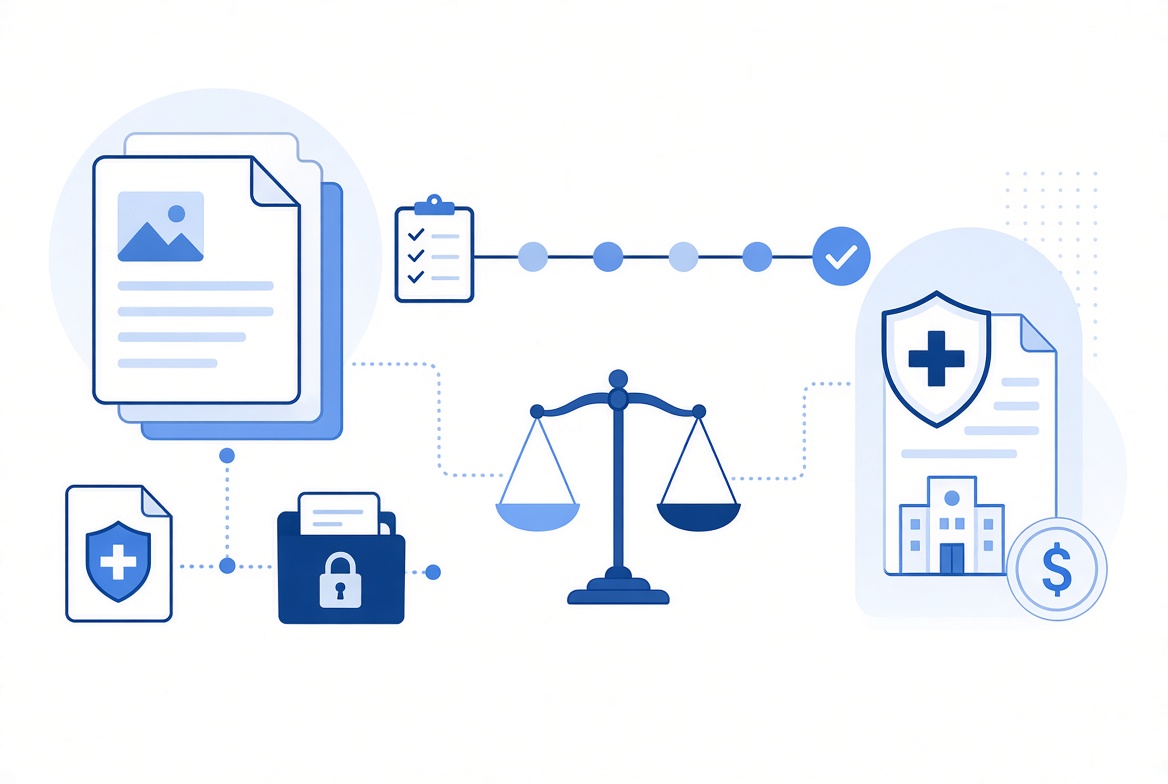
An out-of-network (OON) payment dispute is not always a federal Independent Dispute Resolution (IDR) matter. Before selecting a process, the billing team must determine what claim and coverage are involved, what decision the payer actually issued and which appeal or dispute mechanism applies.
This distinction affects deadlines, required forms, permitted submissions and who may represent the organization. A general billing appeal, a claim correction, an underpayment negotiation and a federal IDR dispute are not interchangeable.
Start with claim classification
Build a documented review record covering the date and setting of service, billing entity, payer and plan, submitted claim, remittance or denial, applicable network status and all prior communications. Confirm whether the coverage falls under a relevant federal or state framework, and whether an exception or exclusion changes the pathway.
Do not infer federal IDR eligibility from the words “out of network” alone. Some disputes may belong to a different payer, state, contractual or legal process.
For a more detailed comparison of these routes, see Millennova Legal’s guide to out-of-network payment dispute pathways.
Preserve the evidence trail
An operational dispute file typically needs the original submission evidence, payer determination, applicable contract or plan information, remittance details, related correspondence, and a chronology of notices and responses. Clinical records may be required for an authorized dispute, but must be handled using the appropriate secure systems—not the website consultation form.
Create an index that distinguishes facts from interpretations. Where a payment calculation is disputed, document the source, calculation method and assumptions rather than presenting the requested amount as an established entitlement.
Choose the actual process before preparing documents
Claims correction: A rejected or incorrectly submitted claim may require correction through the payer’s ordinary claims process.
Administrative appeal or reconsideration: A denied claim may have a defined internal response channel with specific instructions and periods.
Contractual or network dispute: The right response may depend on a provider agreement, assignment, fee schedule or separate payer policy.
Federal or state surprise-billing dispute: Eligibility must be determined from the applicable rules, coverage and circumstances. Federal open negotiation and IDR may have mandatory forms and changing administrative requirements. Verify current official guidance rather than copying outdated timelines from an older blog post.
Professional legal advice should be obtained when legal interpretation or representation is needed. Millennova provides non-attorney operational documentation and process support.
Operational controls for a dispute team
A useful case dashboard records a responsible owner, current stage, verified next-action deadline, submitted documents, payer response status, disputed payment basis and final disposition. For high-volume work, separate the cases that have complete evidence from those requiring provider or payer clarification.
Track submission defects and administrative ineligibility separately from substantive decisions. A case that cannot enter a particular process should not be counted as a settlement failure.
Five questions to ask before outsourcing the work
- How will claims be screened for process eligibility and jurisdiction?
- Which staff members handle clinical evidence, billing data and legal escalation?
- What documents show timely notices, correspondence and submissions?
- How are disputed figures calculated and reviewed?
- Will the provider retain a portable case record if the engagement ends?
Next step: Prepare a business-level summary of disputed payer categories, specialties and approximate claim volumes. Review our NSA and OON dispute operations, or request an administrative case discussion.
This article is operational information, not legal advice. Current eligibility rules, deadlines and authoritative notices should be checked with the relevant official sources and qualified professionals.
Select the remedy before drafting the argument
An OON case could involve a contract payment dispute, adverse benefit determination, state-specific dispute scheme or eligible No Surprises Act federal IDR process. These are not interchangeable. Confirm plan type, state jurisdiction, contract status, service setting and dates before assigning a workflow.
For a contract variance, reconcile the executed fee schedule and remittance. For a coverage denial, preserve the payer’s notice and the relevant plan appeal language. For an NSA dispute, preserve the initial payment or denial and verifiable open-negotiation chronology. Each pathway has different rules and evidence needs.
Minimum evidence packet
| Evidence | Purpose |
|---|---|
| Claim and service-line identities | Prevent mixing similar encounters |
| Original remittance and payer explanation | Establish what was decided |
| Contract or plan language | Identify the controlling payment or coverage rule |
| Clinical and coding support | Confirm the service actually documented |
| Correspondence and delivery receipts | Demonstrate dates and prior process steps |
| Financial calculation | Support the exact amount sought |
Administrative analysts can assemble documents and track milestones, but counsel or qualified subject-matter professionals should resolve contested legal eligibility and representation questions.
Illustrative dispute classification
Suppose an orthopedic practice receives an OON remittance with a low allowed amount. Before drafting a challenge, an analyst should establish whether the issue concerns a commercial contract, noncovered service, state insurance regime or federally protected NSA item. Those facts determine the route; the size of the payment difference does not.
If the payer’s determination is a benefit denial, collect the decision notice and plan appeal language. If the payer paid but allegedly applied the wrong contracted methodology, inspect the contract schedule and line-level adjudication. If the record suggests federal IDR, confirm jurisdiction and the prerequisite process before starting a filing.
Common evidence failures
Missing payer control number: the practice cannot reliably match an appeal to the original claim.
Unsupported requested amount: the packet asserts an amount without showing the applicable calculation and inputs.
Wrong clock: staff assume every appeal uses the same deadline across commercial, Medicare, state-law and federal IDR programs.
A good quality review asks not only whether all documents exist, but whether they establish the specific issue the selected process can actually resolve.
References
Editorial update: October 11, 2026. Confirm the current requirements and applicable payer rules before operational use.