
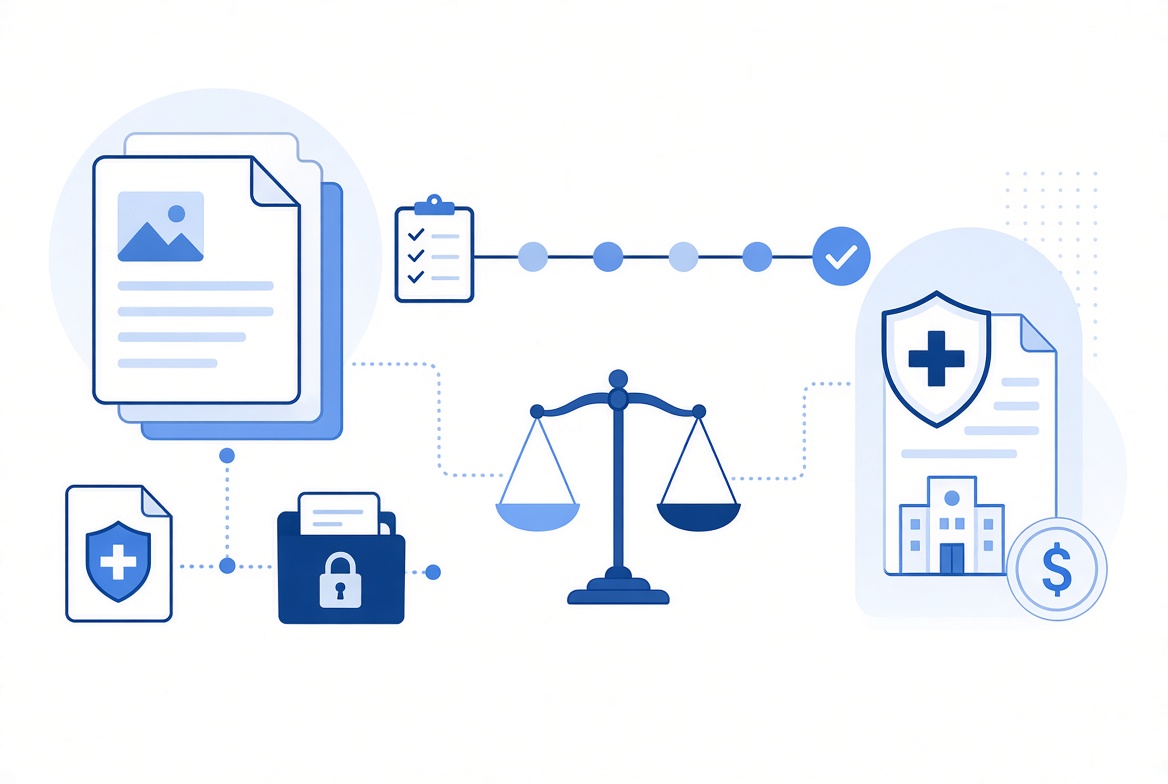
Do not automate eligibility assumptions
Before an IDR case is prepared, confirm whether the claim, coverage and parties fall under the applicable federal process. Differences among commercial plans, state-law processes, service settings and claim history affect whether a particular dispute route is permitted. An out-of-network label is not sufficient evidence of eligibility.
Build a case record before entering the portal
Track the claim identifier inside an authorized system, provider, payer, relevant notices, dates, open negotiation activity, communication history and documents necessary for screening. Each uploaded item should have a traceable source and revision history. The public website consultation form must not be used to collect patient records.
Separate preparation from submission
Automation can organize structured worklists, check missing attachments and remind staff to verify deadlines. Official notices, administrative fees, required forms and portal behavior can change. A responsible, authorized reviewer should verify current CMS instructions immediately before any submission.
Prepare for rejected or incomplete cases
Track the official status returned by the relevant process, whether a notice is defective, and the staff member assigned to remediation. Do not assume a form was accepted merely because an upload succeeded. Preserve a timestamped receipt and the underlying correspondence.
Measure operational quality
Useful metrics include screening exceptions, missing documents, incomplete notices, pending reviews, administrative ineligibility, age of open work, and evidence-reconciliation problems. Payment outcomes should be reported separately and without inflated win-rate claims. For authoritative instructions consult the CMS No Surprises Act guidance.
Next step: See our relevant service overview or request a business-level discussion. This material provides general operational information, not individualized legal, clinical, tax or attest advice.
Keep human eligibility sign-off before portal submission
A case-preparation engine can validate required fields, reconcile claim identifiers and generate document bundles. It cannot determine conclusively whether federal IDR applies by reading an adjustment code alone. Preserve a reviewer decision on plan type, item or service, applicable state law and evidence of the required open-negotiation process.
Avoid unattended portal submissions when a field is ambiguous, a credential expires or CMS changes its operating instructions. Record the portal confirmation identifier and the exact version of the files submitted.
Preflight and postflight controls
| Stage | Control |
|---|---|
| Preflight | Mandatory evidence, identifiers, rule version, fee and open-negotiation chronology |
| Submission | Authorized user, exact offer, filing timestamp and confirmation |
| Rejection | Error reason, ownership and resubmission process |
| Determination | Decision amount, date and permitted further action |
| Financial closure | Remittance, deposits and any unresolved shortfall |
The federal platform and requirements may evolve, including the IDR Gateway transition. Design a procedure that allows staff to respond to changes without risking missed dates. Report completed, accepted cases separately from drafts and failed submissions.
Avoid automating the wrong milestone
What is a drafted case? A packet assembled in internal software. It is not the same as a confirmed submission to the federal IDR platform. Use separate states for ready for review, approved, submitted, acknowledged, rejected, withdrawn and determined.
How should form changes be managed? Maintain a dated schema and a human-authorized update procedure. The existence of an IDR Gateway or new validation field may require updates to preparation workflows without changing the claim’s underlying eligibility.
Can a failed submission be retried automatically? Not without confirming whether the first attempt was received. Duplicate filings can create extra work and potentially affect fee accounting.
Audit trail requirements
Keep each attachment’s filename, version, checksum, permitted sender, submission date and portal response. Store fees, evidence packets and financial outcomes in linked but separate records. Do not allow an AI assistant to assert legal eligibility, generate an unsupported reimbursement rationale or submit on behalf of a party without the requisite authorization.
References
Editorial update: October 11, 2026. Validate current payer requirements and jurisdiction-specific guidance before operational use.