
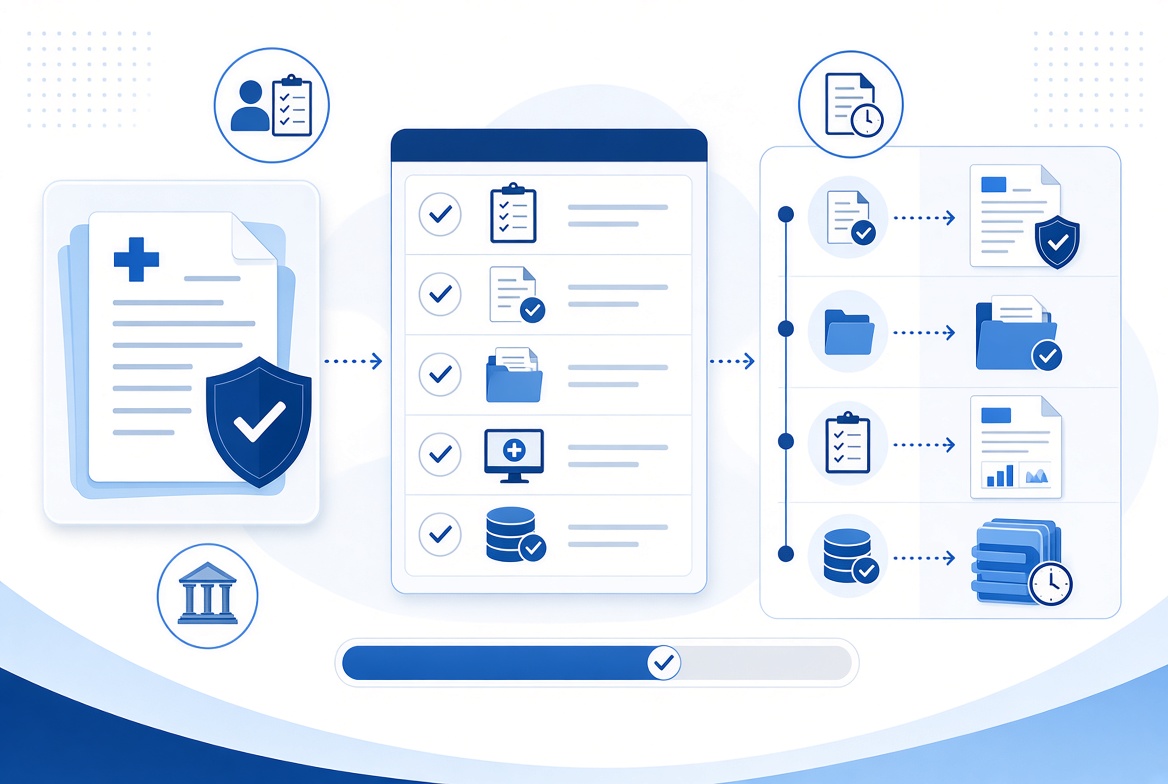
Orthopedic practices often manage procedures that require careful coordination between clinical documentation, insurance eligibility, authorization and scheduling. An authorization workflow can fail even when a clinical team believes an approval is in place: a payer may have approved a different service, location, rendering provider, date range or code set.
Improving the process begins with a record that links the scheduled service to the coverage and authorization conditions actually verified with the payer. Authorization rules vary by plan and service; one insurer’s policy should not be generalized across all contracts.
Build one auditable request record
An authorization work queue should allow authorized team members to see, at minimum:
- Practice, rendering provider and anticipated service location.
- Insurance plan and relevant coverage verification date.
- Requested procedure or service description and applicable coding information.
- Ordering/referring documentation and available medical necessity evidence.
- Authorization submission channel and confirmation identifier, if any.
- Payer status, requested additional information and next follow-up date.
- Approval or adverse response, authorized scope and relevant effective dates.
- Assigned owner and escalation point before the scheduled service.
A shared tracker is not sufficient on its own. Ownership rules and access controls must also be defined, and sensitive information should reside only in approved systems.
Separate coverage, referral and authorization
Eligibility verification can indicate coverage status but does not guarantee that a particular service will be paid. A referral is not automatically equivalent to prior authorization, and an authorization approval is not necessarily a promise of payment.
Treat these as distinct checks. If payer requirements are uncertain, obtain clarification using authorized practice channels and keep a record of the source and response.
What should happen before surgery or an intervention?
A practical pre-service review can confirm whether the documented procedure, provider, location and date range align with the payer’s recorded decision. If the operative plan changes, staff should determine whether the authorization record requires an update.
The workflow also needs an exception path for urgent scheduling, unavailable payer systems and incomplete documentation. Escalations should be visible to both appropriate clinical and administrative personnel.
Manage adverse decisions separately
When an authorization is denied, delayed or modified, first identify the payer’s stated reason and applicable response route. A request for missing evidence is not the same as a final adverse determination. Clinical staff should review medical necessity assertions; billing staff can organize records, response dates and payer communication.
Avoid treating the same appeal deadline as universal. Applicable rights and timelines depend on the plan and specific decision; check the operative payer materials before recommending an action.
Metrics worth reviewing
Compare authorization turnaround time by payer, the age of pending requests, late requests discovered near the scheduled service, requests returned for missing documentation and authorization-related claim denials. Do not assume a change in denial count proves improvement unless the practice’s volume and case mix are also considered.
For practice leaders: Ask whether your existing billing provider owns authorization exceptions, merely reports them, or expects clinical staff to resolve them independently. A transition checklist should spell out the responsibility boundaries.
For a discussion of coordinated orthopedic billing and payer follow-up, see medical billing services or request a scoped practice assessment. No patient information is needed for an initial consultation.
Connect authorization to the procedure actually performed
For orthopedic surgery, an authorization may be present but no longer match the scheduled procedure, site, rendering provider or date. A useful pre-surgical control reconciles the clinical order, proposed CPT family, documentation required by the plan, authorized units, expiration and participating facility. Never interpret an authorization number as blanket assurance of coverage or payment.
Separate clinical necessity review from scheduling and billing validation. If the operative plan changes, record who assesses whether a new authorization or amendment is required.
A five-gate orthopedic checklist
| Gate | Evidence |
|---|---|
| Coverage | Member and benefit verification |
| Referral | PCP or network requirement, where applicable |
| Medical necessity | Records supporting payer clinical criteria |
| Authorization match | Procedure, location, rendering clinician, validity period |
| Claim consistency | Operative report, coding and transmitted authorization data |
Report requests pending, requests denied, authorizations expired and authorized services mismatched as distinct queues. This helps isolate problems that can be resolved administratively from those requiring surgeon documentation or payer clinical review. The CMS interoperability rule addresses selected payers; individual commercial plan requirements still need separate checks.
Preoperative and post-decision checks
Does approval guarantee payment? No. Eligibility, benefits, medical necessity, coverage exclusions, claim coding and payer policy can still affect adjudication. Document what the authorization actually covers.
What if the procedure changes during surgery? The team should compare the performed service with the authorized service and determine any needed follow-up under the governing payer policy. Do not assume every related CPT code is covered by the original authorization.
Who should answer a clinical request? Clinical personnel should provide the medical evidence; billing staff should track the payer request and its deadline without inventing medical necessity language.
Suggested exception dashboard
Report pending clinical documents, requests denied for missing information, expired authorizations, scheduled services with unmatched approval and claims denied despite recorded approval. The latter category is especially useful for identifying payer processing discrepancies rather than only intake failures. Record the final claim outcome before declaring a preventive control successful.
References
Editorial update: October 11, 2026. Validate current payer requirements and jurisdiction-specific guidance before operational use.